
For small marketing teams, the pressure to produce high-quality, consistent material often feels like a battle against the clock. Managing the demands of blogs, social media, and SEO can quickly drain resources, leaving little room for thinking about strategy. This is where AI content workflows come into play. By integrating AI systems into your daily routine, you can transform a rushed production schedule into a streamlined process.
Implementing AI content workflows is about much more than simply replacing human effort; it’s about enhancing it. This can allow your small team to achieve the output of a much larger department without the associated cost or risk of burnout. These systems help ensure that every hour your team spends on marketing is dedicated to refinement and strategy rather than just manual labour.
The Content Bottleneck in Lean Marketing Teams
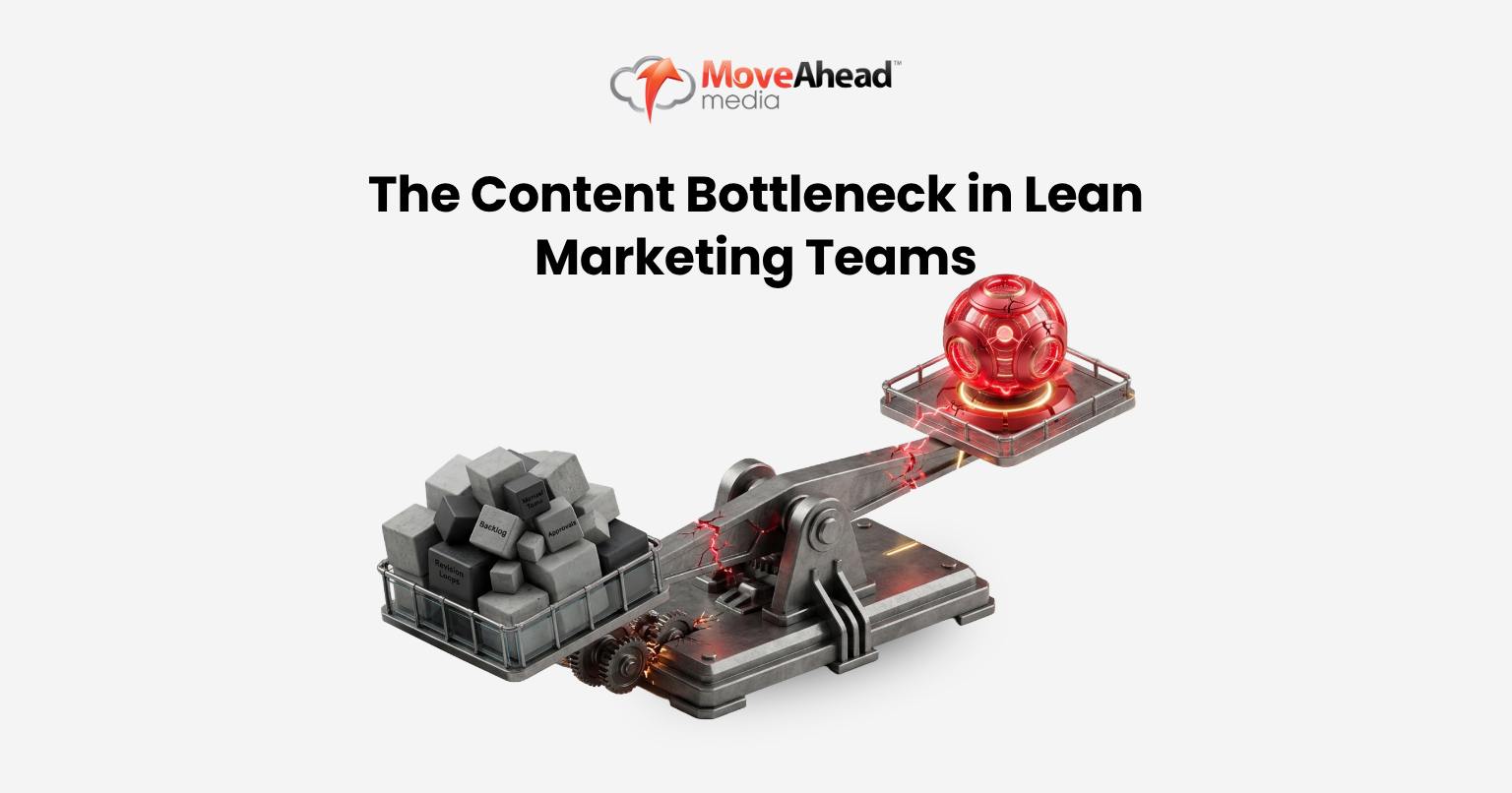
Most small agencies and in-house teams face the same bottleneck hurdle. You might have brilliant ideas, but the manual execution can often take days rather than hours. When every team member is wearing multiple hats, as is often said within the industry, content often becomes the first thing to slip. This can result in inconsistent posting schedules and missed opportunities to achieve high-ranking positions.
AI for marketing teams offers a way out of this never-ending cycle. By identifying repetitive tasks that eat up your limited time, you can use content automation tools to handle the heavy lifting. The goal is to move away from repetitive content production and toward a model of AI content operations where your staff spends more time on overall direction and less time on time-consuming drafting and formatting.
To break the bottleneck, teams must adopt the rule of thumb outlined by former Apple and Meta marketing leader Shachar Scott: “Automate the predictable, elevate the judgment.” Writing in Inc. Magazine, she reinforces that structured, rule-based tasks should be automated, while strategic and creative direction should be led firmly by humans.
When you remove the tediousness of tasks such as meta-description generation, you free up the mental space required for genuine strategy and creative thinking. Small teams often fail not because of a lack of talent, but because of a lack of time. Correctly using AI content workflows can effectively give you that time back.

How to Map Out Your AI Content Operations
As rewarding as it can be, the transition to AI content automation still requires a comprehensive roadmap. It’s important to look at your existing journey from the initial idea to the live output and then identify the points where you may struggle. Mapping out your AI content workflows involves pinpointing exactly where a machine can speed up the process without sacrificing the unique perspective of your brand.
It’s important to note that this isn’t a one-size-fits-all solution, but rather an approach where different tools handle different stages of the lifecycle. This lifecycle will range from the data-heavy research phase to the creative refinement stage. By identifying the areas where you need AI content operations, you ensure that the quality remains high even as the speed of delivery increases.
A refined workflow allows you to onboard new team members faster and ensures that everyone is using the same tools in the same way. Without this structure, AI usage can become fragmented and inefficient. A clear strategy for when you plan to use AI content workflows ensures that your automation efforts have a clear impact, supporting your long-term SEO and marketing goals simultaneously.
Ideation and Research
Using AI for marketing teams during the research phase can cut down the initial legwork by hours. Instead of manually digging into competitors or trend reports, you can use AI content workflows to gather data and suggest topics that are relevant to your specific audience. This involves using prompts to analyse top-performing content in your niche and identifying gaps that your brand can fill.
This stage is also the perfect time to look into AI seo to ensure your topics align with search intent. AI productivity marketing can succeed here by providing data-backed suggestions that would take a human researcher a full day to compile. By the time a writer sits down to work, they should have a comprehensive brief generated by your AI content workflows, complete with target keywords, target audience notes, and a list of potential questions that users may want answering.
Drafting and Structuring
Once the research is settled, the next step is to automate content creation. Rather than writing from scratch, marketing teams can use AI to generate detailed outlines, headers, and initial drafts based on specific brand guidelines. This ensures that the core of your SEO content writing services remains focused and consistent. AI can suggest the logical flow of an article, ensuring that H2s and H3s are crafted to guide the reader naturally through the topic.
By using AI content workflows to shape your articles, your writers can focus on adding real-world insights, case studies, and a sprinkle of personality, rather than worrying about word counts and basic sentence structure. This is where AI content automation really shines. These tools can handle the bulk of the content, so your team can spend their energy on what truly provides value to your readers.
Editing and Localisation
The final hurdle is ensuring the content is polished and ready for your audience. AI content automation excels at checking for grammar and tone, ensuring that even if three different people worked on a project, it sounds like it has the same voice. This is especially true if you are operating across borders. SEO localisation strategies can be greatly assisted by AI translation tools that understand context better than traditional software.
Within your AI content workflows, the editing phase acts as the final filter. You can instruct AI to review your final draft and look for potential flaws, repetitive phrasing, or areas where the tone may be too academic. This ensures that while the speed of production has increased, the quality has not been reduced. This is a key component of modern AI content operations, as it helps address the stigma often associated with low-quality, batch-made content.

4 Top AI Tools to Automate Content Creation
To truly automate content creation, you need a stack that plays well together and fits into your existing tech stack.
ChatGPT or Gemini
Consider using ChatGPT or Gemini for first-stage creativity and drafting, as these are often the go-to choices of most AI content workflows. Their ability to process large amounts of information and mimic specific voices makes them invaluable for the early stages of production.
Jasper and Copy.ai
Tools like Jasper and Copy.ai offer templates specifically designed for marketing copy and social posts, making AI content automation more accessible for those who aren’t engineering experts.
SurferSEO
SurferSEO can become an essential tool for ensuring your AI content operations are actually hitting the marks required for search rankings. This tool, and others similar, can help bridge the gap between content that reads well and content that actually performs.
Grammarly and Hemingway
Grammarly and Hemingway provide the AI productivity marketing edge needed to keep prose tight, readable, and free of passive voice. If grammar is something you struggle with, especially when creating content at speed, these tools can quickly become invaluable.

Maintaining the “Human-in-the-Loop” Approach
A common fear is that relying too heavily on AI content workflows will lead to a robotic final product that fails to connect with real people. To avoid this, you must maintain a “human-in-the-loop” philosophy. AI for marketing teams should be viewed as a co-pilot, not the pilot. While the AI can generate the data and the draft, a human must provide the actual substance. Humans are still required to fact-check, ensure audience relevance, and align the output with the overarching marketing strategy.
When efficiently using AI content operations, the AI should do the 80% of the work that is predictable and data-driven, leaving the 20% that requires true creativity and talent to your marketing team. This might involve adding a personal anecdote, a unique client testimonial, or even a controversial opinion. This balance is what makes AI productivity marketing so effective. Without human oversight, you risk producing bland content that may rank well but will never drive conversions.

Start Reclaiming Your Time Today
The transition to AI content workflows doesn’t have to happen overnight, and trying to change everything at once is a recipe for conflict. Start by choosing one specific issue your team is having and then apply content automation tools to address that single task.
Measure the time saved and the quality of the work produced. You can then use those results to get buy-in for using these tools in other areas – the proof is often in the pudding. As your team becomes more comfortable with AI content automation, you can expand your AI content operations to cover the entire content lifecycle.
By choosing to automate content creation where it makes sense, you can give your team the breathing room to innovate and think bigger. Modern digital success will be built on AI content workflows that empower humans to do their best work, allowing small teams to compete on a larger scale.
Interested in learning more? Here are some additional resources: