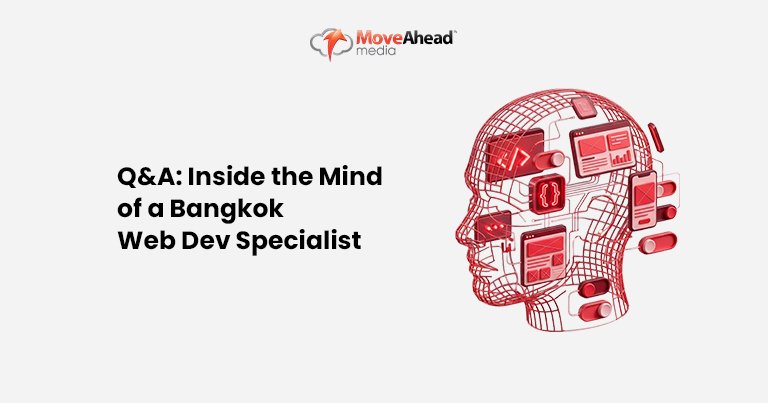
Have you ever clicked on a really good website? Not just any regular website, but one that felt instantly trustworthy. You didn’t have to wait for it to load or rummage for the review section because it was right there in front of you. Maybe the connection was so strong that you converted on your very first visit.
That’s the dream for any entrepreneur: to build a website so compelling your audience has no choice but to act. The question is, how do you get to that point? We sat down with Fai, our highly experienced web developer in Bangkok, to unveil what every business in Thailand should be prioritising.
Stay with us as we talk you through it.
What Makes a High-Converting Website in 2026?
A high-converting website maximises your ROI, and who isn’t striving for that? It’s a goal that should be high on your radar. But what are the key elements?
According to Fai, the fundamentals haven’t changed:
“Speed is still king. If your site takes more than three seconds to load, you’ve already lost a chunk of your audience before they’ve even seen your homepage.”
She goes on to explain that trust signals matter more than ever: “Clear contact details, genuine reviews, and an SSL certificate are table stakes now.”
However, there has been an undeniable shift. “Users now expect personalisation and clarity,” Fai says. “They want to land on your site and immediately understand what you do, who it’s for, and what to do next.”
If there’s any confusion in those first crucial seconds, they’re gone. Whoosh, vanished into thin air. Your window to impress is excruciatingly short. When you’re building a site for conversion, you need to be building for clarity. As Fai puts it: “Every element on the page should be earning its place.”

UX vs UI: A Developer’s Honest Opinion
It’s impossible to talk about high-converting websites without bringing UX and UI into the conversation. But you’re a busy entrepreneur. Meanwhile, your developer might be flustered with hundreds of tasks, or you might not even have one in the first place. So, between the two, which one deserves your attention?
“If I had to prioritise between UX and UI, I would choose UX every time,” Fai shares.
“A beautiful website that’s confusing to navigate will frustrate people. A plainer site that’s intuitive and fast will keep them engaged and coming back. That said, in a market where first impressions happen in milliseconds, UI does the heavy lifting for credibility.”
Okay, now the confusion is even more palpable, and we hear you. Credibility is huge for building trust, but a seamless user experience is just as important, so where exactly does that leave us?
3 Things Every Thai Business Needs on Their Homepage
Now that we’ve covered the technical side, let’s get into the exciting part. Your homepage is the very first point of contact customers have with your business. Do you want to make things easy for your customers or lead them through a labyrinth just to find your email address?
It seems obvious – you should opt for the straightforward option, but many businesses forget to consider that.
To guide you, we asked Fai what 3 things every business needs on their homepage; she shares:
“The first thing is LINE integration. In Thailand, LINE is where business relationships happen. If visitors can’t click straight through to your LINE OA from your homepage, you’re losing leads to friction. Make it prominent, not buried in a footer.”
She goes on to say that building trust in a Thai context is vital: “This means displaying your DBD registration, real-time photos, and ideally some customer testimonials in Thai. International trust badges alone don’t land the same way here; local credibility markers matter.”
Lastly, Fai explains that a Thai business website needs to prioritise mobile-first at all times.
She says: “Thailand has one of the highest mobile browsing rates in Southeast Asia. Your homepage needs to look and perform flawlessly on a phone screen, not just be ‘mobile-responsive’ as an afterthought. That means tap-friendly buttons, fast-loading images, and content that doesn’t require pinching and zooming.”
Build Your Dream Site Today
Many businesses focus on creating a visually stunning site, thinking that’s how customers are going to get pulled in. Yes, beautiful design certainly makes a great impression – similar to how you feel captivated watching the sunset over a temple – but your customers actually need to be there in time to see it. If your load time is atrociously long, that window of opportunity is long gone. A conversion focused design gets them to stick around.
As a business in Thailand, you might have mastered multitasking, but trying to handle your own dev work risks a massive loss of opportunity. Our website development services cover the entire journey, including technical aspects you may not have thought of.
Don’t let a poorly optimised website be the reason your customers don’t follow through. Consult our web design team and discuss your vision with us today.